
You can now use our Document Analysis endpoint to extract and check data on 4 new document types :

  • French and Italian vehicle registration certificates (Carte grise and Libretto auto respectively).
  • French auto insurance claims history documents (commonly called Relevé d'informations).
  • Italian temporary vehicle registration certificates (commonly called : Permesso di circolazione).

To request a new Document Analysis for these new types use :

  • "type" : "vehicle_registration_certificate" / " temporary_vehicle_registration_document" / auto_insurance_claims_history"
  • country_code : FR/IT

To check whether the vehicle_owner or policy_holder appears on the document, you can optionally add checks and follow the status.

Follow the full guide on Document Analysis here

We’re introducing the Certified Identity Verification - PVID, an ANSSI‑certified remote identity verification that provides an assurance level equivalent to in‑person checks.

To launch a PVID verification, use the creation endpoint POST /verifications/identity_videos (see API reference) and set the pvid parameter to true . Then share the generated verification link with the person to verify.

What’s different vs. standard Video Identity Verification:

  • Automated face and document challenges during the flow
  • Systematic human review on every verification
  • A dedicated “proof file” (distinct from the Audit Trail) available in case of dispute

For more information about Video Identity Verification products differences, please consult our guide.

A new custom_recipient_order parameter is available on Initiate and Update Signature Request endpoints.

When set to true, you define the execution order of all recipients together, regardless of role.

Approvers can be placed at any position in the flow, and recipients can act in parallel within an ordered sequence.

Existing behavior (custom_recipient_order = false) is unchanged. For full details, see Configure Recipient Ordering.

You can now verify the existence of a company in Spain and, when available, retrieve structured official company data.

Start a verification with the Company Verification creation endpoint POST /verifications/companies (see API reference).

  • The company_number: the NIF code: 9 characters (leading letter, 7 digits, and a control character).
  • Set country_code = ES

For more details on how to verify a company in Spain, please refer to our dedicated guide section here.

You can now retrieve a Verified Identity Proof in PDF format, including the ID documents used during the identification, for Qualified Electronic Signatures (QES) when the associated identification was completed through Video Verification via the endpoint GET /signature_requests/{signatureRequestId}/signers/{signerId}/verified_identity_proof/download.

This proof is available only if:

  • Have at least the API PRO plan;
  • the QES is successful,
  • the identification was performed via Video Verification,
  • the identification data has not been anonymized (the proof remains available until anonymization — currently 90 days after identification).

Not available for:

  • identifications completed using a Saved Identity (no access to underlying identity documents, so the proof cannot be provided).

For more details, please refer to our dedicated guide section.

API and Webhook Log retention now depends on your plan:

PlanLogs retention
Plus24 hours (NEW)
Pro7 days
Scale30 days (NEW)

For more details, see API & Webhook Logs.

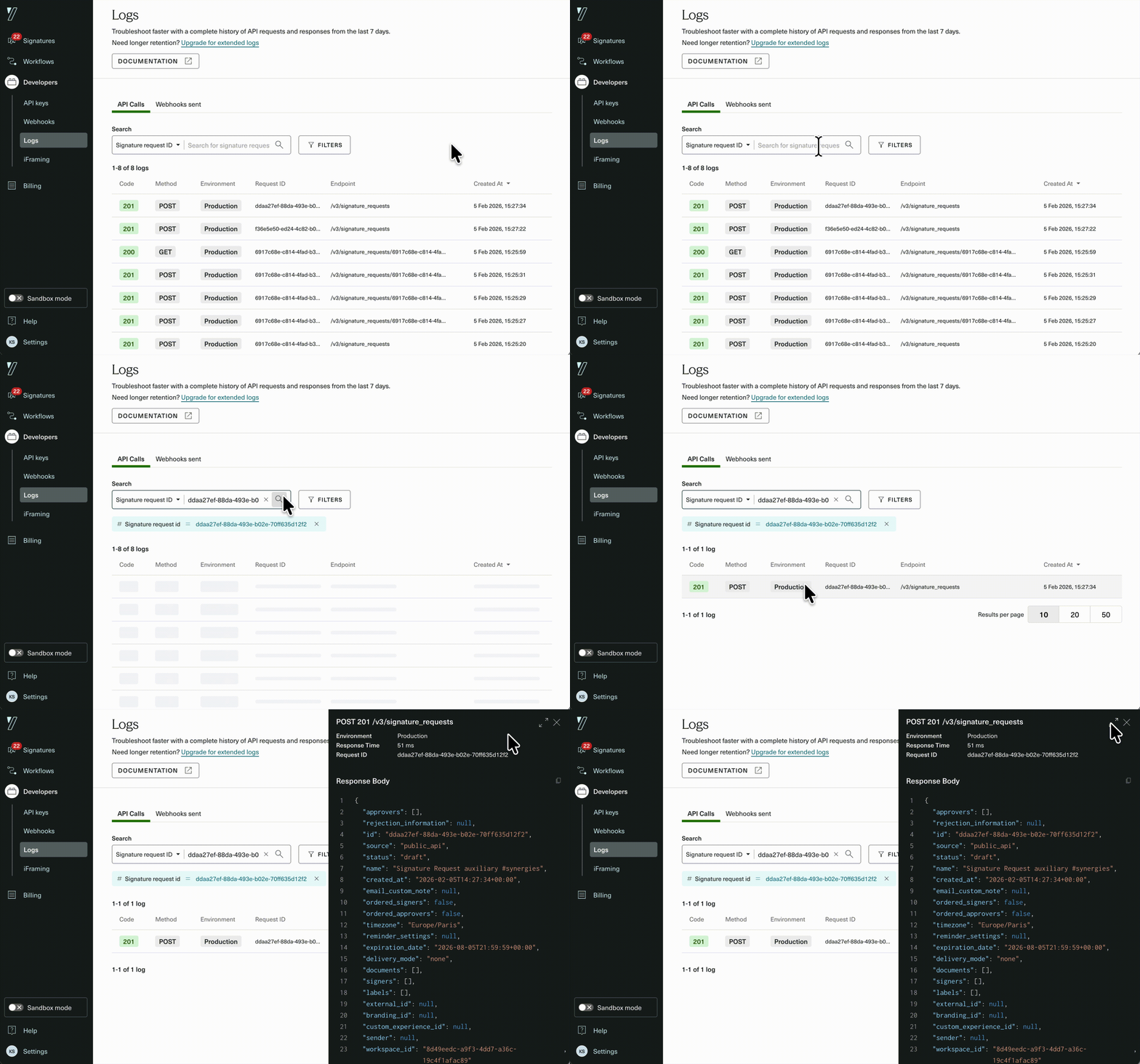
We’ve shipped multiple improvements to theLogs pages in the app to help you debug faster and find the right events more easily:

  • Search logs by Signature Request ID to jump straight to a specific request.
  • GET requests are now recorded in the Logs.
  • Open log details in a full‑page view for better readability.
  • Filter logs by a custom time range.
  • Choose how many results to display per page.
  • Request and response bodies for multipart/form-data are now captured.
  • Filter logs by API key to isolate traffic per integration.
  • Access the Logs for a given Signature Request directly from its details page.

For more details, see API & Webhook Logs.

You can now duplicate an existing Signature Request to create a new one based on the same configuration.

To do so, call the POST/signature_requests (see API reference) endpoint, and provide the signature_request_id of the Signature Request you want to duplicate.

The API creates a new Signature Request in draft status with a new id.

Learn more in the guide.