Qualified Electronic Signature (QES) now supports multiple Signature Fields per Signer per Document. Previously, adding more than one QES Signature Field triggered a blocking error: this restriction has been removed.

Key behaviors to be aware of:

  • Single Signature: A single cryptographic Signature covers all signature images on the Document. This differs from SES and AES, but meets the legal requirement — one technical Signature is sufficient for a valid electronic signature.
  • Signature panel: With multiple QES Signature Fields converted directly into images, clicking a Signature Image in an external PDF reader will not open the signature panel directly. The panel is still accessible and of course the Signature remains valid.
  • Locked PDFs: Multiple QES Signature Fields are not supported on locked PDFs.

For full details, see the QES level specificities guide and the Signature Fields API reference.

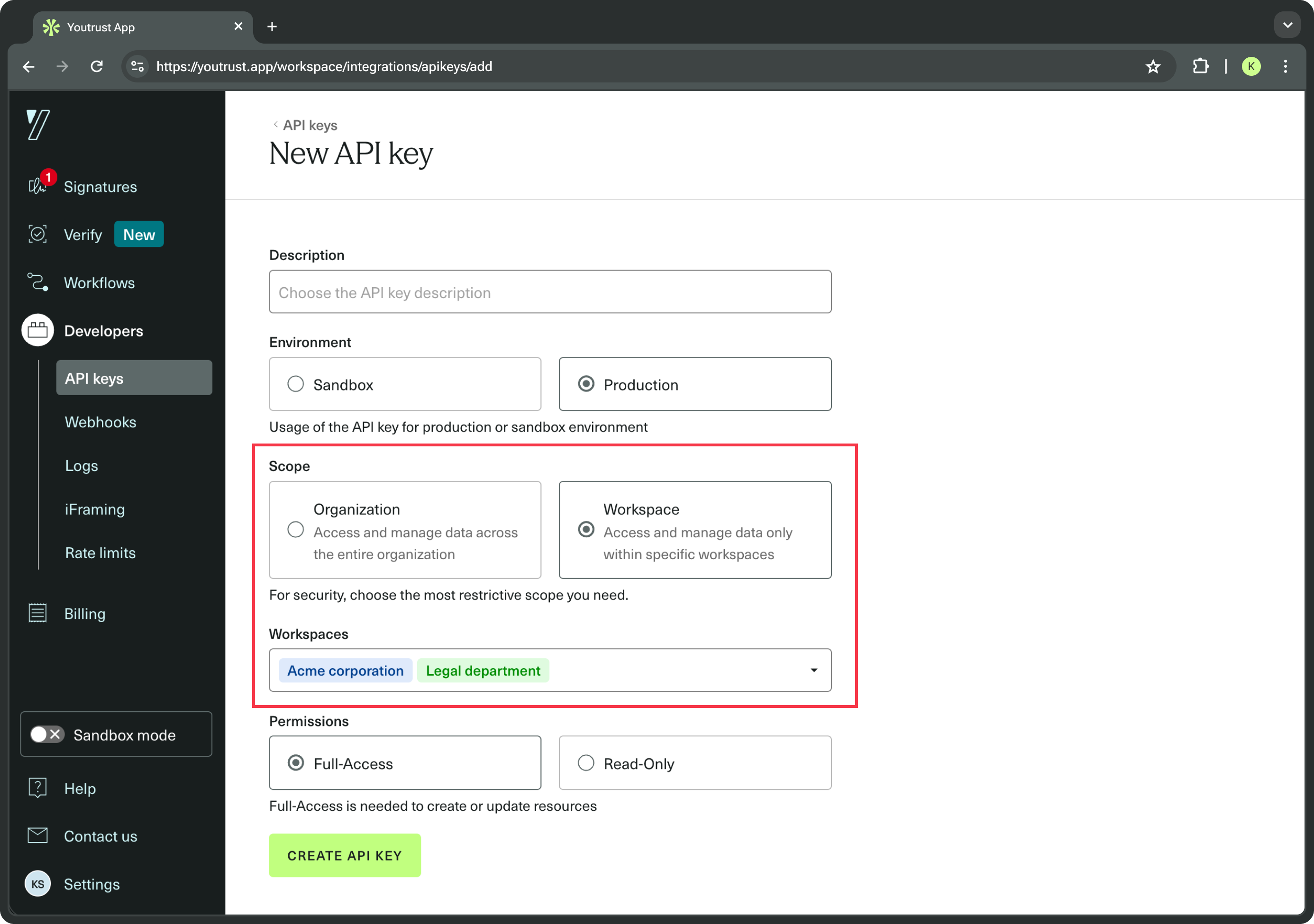
You can now scope API keys to specific workspaces and benefit from a higher API key quota.

Workspace-scoped API keys [NEW]

API keys now support two types of scope:

  • organization: the key can access data across your entire Yousign organization.
  • workspace: the key can access data only for selected workspaces.

This is useful if you:

  • Manage multiple entities in separate workspaces, and want separate keys per entity to isolate access.
  • Want to apply least-privilege access for improved security

API key quota increased

  • Before: 5 active API keys per organization
  • Now: 200 active API keys per organization
📈

Need more API keys?

If you are on the Scale plan, we can increase your quota. Please contact the customer support.


To learn more, see our guide on API keys.

You can now define Custom Properties on Signature Requests (dropdown lists and free text) to categorize and track Signature Requests across your team. Properties are managed at organization level and optionally scoped to specific Workspaces.

Custom Properties can be created and managed via the new /custom_properties resource (see API reference).

To use them on Signature Requests, pass the new custom_properties parameter when calling POST /signature_requests or PATCH /signature_requests/{signatureRequestId}.

Property values are returned in GET /signature_requests and GET /signature_requests/{signatureRequestId} responses, and included in Signature Request Webhook events.

Two new filter parameters on the list endpoint (custom_property_value_id and custom_property_value) let you query Signature Requests by property values.

Available on Pro and Scale plans. For full details, see the Custom Properties guide.

You can now view your API rate limits directly from the new Rate Limits page in the Developers section.

In-app Rate Limits page

This page makes it easier to check your current limits in Production and Sandbox, anticipate usage, and request an increase when needed.

A new Rate Limits documentation page is also available, containing updated guidelines and best practices to stay within limits.


You can now add a text caption directly inside an Electronic Seal Field area using the new captions parameter on POST /v3/electronic_seals (see API reference).

The caption is rendered below the seal image, within the same Field area. It is useful to display a short label tied to the seal visual — such as a department name or internal reference — without placing a separate read_only_text Field next to it. Unlike read_only_text, it can be used on already-signed documents without breaking prior signatures.

Key constraints:

  • captions accepts an array with exactly one entry.
  • text must not exceed 150 characters.
  • Font size is calculated automatically to fit the available space; adjust the size of your image, width or height parameters to control line wrapping.
  • The parameter is optional, omit it entirely to render no caption.

For full details, see the Add Caption to your Electronic Seal guide.

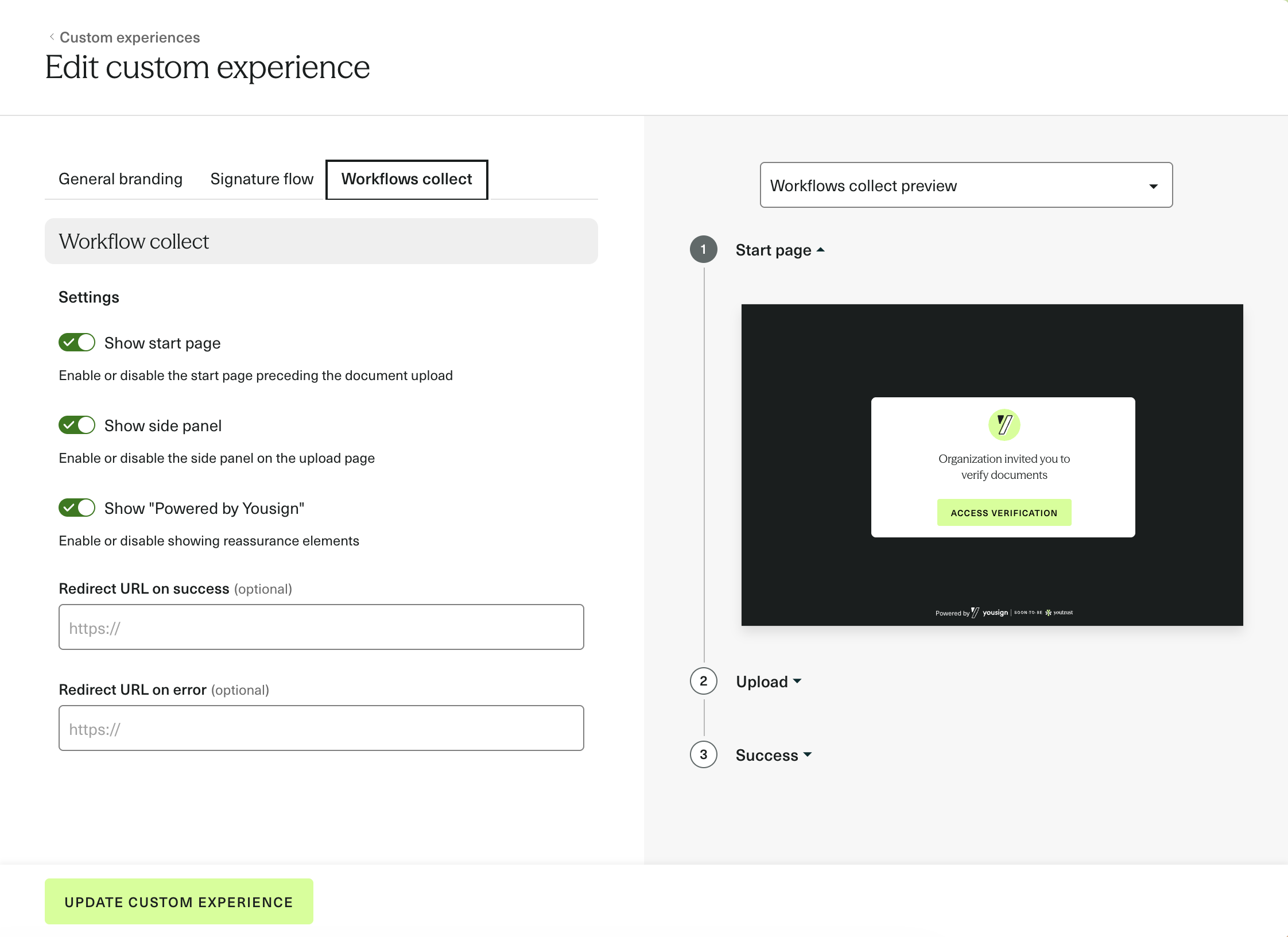
It is now possible to iFrame Workflow Collect for an embedded experience at low development cost. iFraming Workflow Collect works similarly with iFraming the signature flow.

When iFraming Workflow Collect, we emit the following events to help you manage the integration :

  • started: the Applicant has opened the Workflow Session Link.
  • processed: the Applicant has comlpeted all Actions successfully and has no additional actions to take.
  • blocked: the Applicant has reached the limite of retries for a given verification and can no longer upload documents for verification.
  • ping : Workflow Session link is loaded.

To learn more about how to iFrame Workflow Collect, follow our complete guide here.


You can now analyze French tax notices with Request a Document Analysis. This helps you automate income verification and extract key tax notice data from supported documents.

For the tax_notice document type, Document Analysis now extracts:

  • fiscalNumber1
  • fiscalNumber2
  • taxNoticeReference
  • issuanceDate
  • incomeYear
  • referenceIncome

You can also send optional consistency-check parameters when creating the analysis:

  • first_name — checks that the provided first name matches the document
  • last_name — checks that the provided last name matches the document
  • income_year — specifies the tax filing period

To learn more, see the Document Analysis guide.

We're introducing new dedicated Webhook events to help you follow more efficiently the status of an Applicant inside a Workflow Session.

  • applicant.notified: triggered when a Workflow Session Link has been generated for your applicant.
  • applicant.processed: triggered when your Applicant has completed all the attached verifications and has no additional action to take.
  • applicant.session_blocked: triggered when an Applicant is blockedand can't perform any additional actions on the Workflow Session Link.

Read the full documentation here


You can now enforce business rules when creating an Image Identity Verification. Configure the new parameters with the request endpoint POST /verifications/identity_documents (see API reference):

  • min_age - minimum accepted age
  • max_age - maximum accepted age
  • prohibited_countries - list of issuing countries to reject

If a configured rule is not met, the verification returns a failed status with a dedicated status code.

See the status code mapping on this page, and learn how to configure these checks in the guide.

You can now reuse a decision from the Image Identity Verification endpoint (see the reference) to complete one Advanced Electronic Signature (AES). This avoids running a second verification when initiating the AES.

How it works:

  • First, perform an Image Identity Verification and keep the decision ID from the response (see the reference). Please not, for the moment, verification via Video Check (see the reference) cannot be reused in an AES context.
    • Identification must be verified;
    • And must be used within 7 days, otherwise the Signature Request will be cancelled in full because the identification associated for a Signer will be anonymised.
  • When you initiate the AES with the Signature Request creation endpoint POST /signature_requests/{signatureRequestId}/signers, include that ID in the payload via the verified_identity_id parameter (see API reference).

To access this feature, you must have at least a PRO API plan and contact a sales representative to activate access to this endpoint for your organisation.

For more information about the feature, you can consult our dedicated guide.